
Frederick County VINE Coverage
VINE means Victim Information and Notification Everyday. The service is reached through VINELink. For a person held at Northwestern Regional Adult Detention Center, Virginia Jail VINE is the relevant custody-event and notification route because NRADC is a regional jail serving Frederick County. Coverage depends on the participating agency's feed. Always read the reporting agency named in the result instead of assuming every Virginia record describes NRADC.
Virginia has distinct notification tracks. Jail VINE handles participating local and regional jail events. VADOC uses NAAVI for eligible victims concerning people in state correctional custody. The Virginia State Police registry has a separate, narrow statutory purpose and does not function as a general release service. Registration in one system does not move into another when custody changes. A person transferred from NRADC to VADOC may therefore require a new registration through the state-custody channel.
Search Frederick VINELink Records
Search for one person at a time. Use the full or partial name and an offender ID where the interface supports it. Name-only results can include more than one person, so compare the available descriptors and reporting agency before opening a record or registering for notices. A Frederick County court case may lead to an NRADC record, but the regional jail also serves Clarke, Fauquier, and Winchester. The agency and identity fields matter more than the jail's Winchester address.
- Open VINELink and choose Virginia as the jurisdiction.
- Select the offender or custody search offered for Virginia Jail VINE.
- Enter the full or partial name, plus the offender ID when known and supported.
- Compare possible matches by reporting agency and all available identity details.
- Open the correct record and copy the custody status, location, and event text exactly.
- Note the retrieval date and time before using the jail or court to corroborate the event.
Do not force VINE's words into a broader conclusion. If a record says released or out of custody, preserve that phrase. If it says transfer, preserve transfer. A missing result may reflect a name variant, data timing, agency participation, movement to another system, or no matching record. The Frederick County released inmate lookup covers the wider cross-system path when VINE alone does not resolve the person.
The official VINELink entry point shown in the manifest is the correct place to select Virginia, search a record, and begin registration.
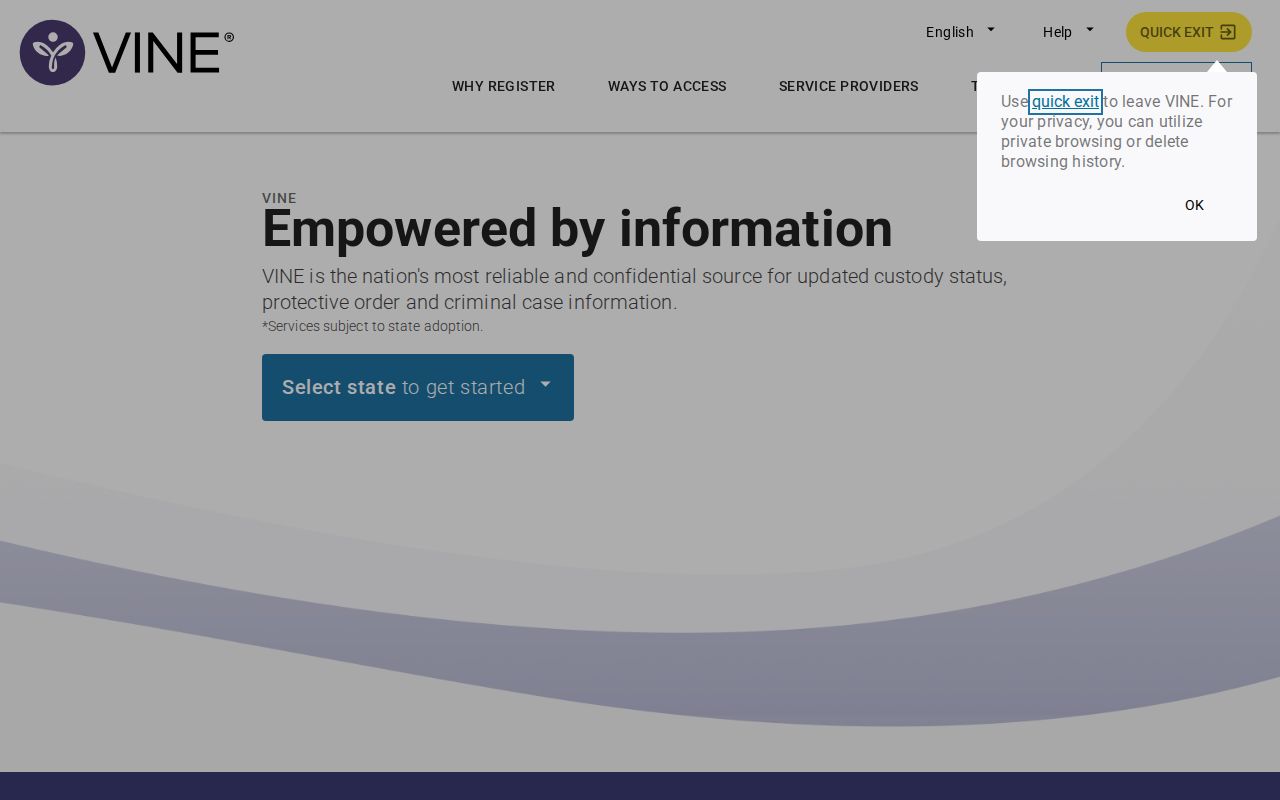
The screen leads to the reporting-agency record whose exact status must then be checked against NRADC or the responsible Virginia custodian.
Frederick VINELink Release Fields
Available fields can vary by agency, legal status, and data feed. The Frederick County check should record only what the live result actually displays. VINE is a notification service, not a full criminal-history archive. It may show enough to identify a custody event but not the court order, bond posting, sentence calculation, or destination needed to explain it.
| Field | How to read it |
|---|---|
| Name and descriptors | Use them to distinguish the correct person from similar names. |
| Offender ID | Preserve the identifier when offered so later checks stay tied to one record. |
| Reporting agency | Shows which jail or corrections body supplied the event. |
| Custody status | Copy the exact current, released, out-of-custody, or transfer wording shown. |
| Facility or location | Identifies where the person is reported or which agency controls the record. |
| Event language and date | Provides the reported status change without necessarily explaining its legal reason. |
A VINE event does not replace the completed custodian record. For an NRADC episode, request the booking number, release date and time, release reason, and transfer destination. The court's bond, dismissal, sentencing, or release order may explain authority but often lacks the physical exit time. Pair the sources rather than choosing the one with the simplest wording.
Note: Capture the agency, identifier, exact status, event time, and retrieval time so a later update can be understood.
Register Frederick Release Alerts
Open the verified record before registering. Virginia Jail VINE supports telephone, text, email, TTY, and app channels as available in its workflow. Choose a method that can be monitored and keep contact details private. The options offered on the live record control. Do not assume every channel uses the same confirmation step or that an alert will arrive at a guaranteed moment.
- Select the "Get notified" or registration option from the correct person's record.
- Choose an offered phone, text, email, app, or accessibility delivery method.
- Enter and confirm the destination information carefully.
- Create a PIN when the telephone workflow asks for one.
- Accept the service terms and complete the code, link, or other confirmation shown.
- Test or update the channel as instructed and repeat registration in a receiving system after a transfer.
For telephone calls, entering the PIN acknowledges receipt and stops repeat calls. The research does not support claiming that the same phone PIN is required for email or text. Virginia's published TTY number is 866-847-1298. Maintain other plans and contact the responsible agency directly when immediate accuracy is needed. VINE should support, not replace, direct verification.
Frederick Jail and State Alerts
Virginia's sentence boundary can make notification routing less obvious. The official workflow directs sentences under 12 months to Jail VINE. For sentences of 12 months or more, an eligible victim uses VADOC notification. A state-responsible person serving under two years may remain physically in a local or regional jail while VADOC calculates the release date. In that situation, physical location, sentence authority, and the proper alert service do not neatly match.
Registration in both systems may be needed while the person remains at NRADC under state authority. If the person later enters a VADOC institution, use the state's current notification instructions. The official VADOC notification page explains that state-custody route and its separation from Jail VINE.
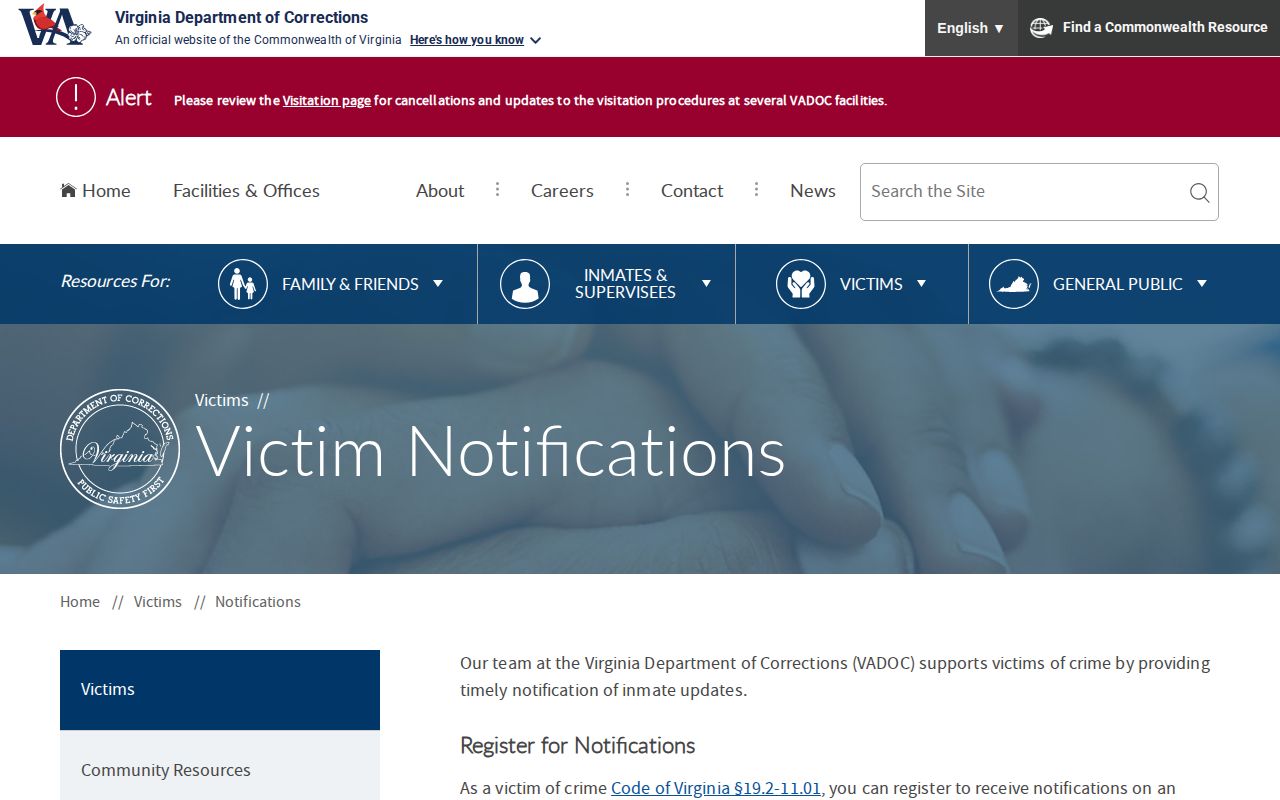
The captured page reinforces that a Frederick County jail alert and a VADOC state-custody notification are separate registrations tied to different custodial phases.
A state-custody alert also has to be read with the VADOC record. A projected date can change. A completed release document, such as an Order of Release or notification-of-release letter, has more weight than an estimate. If the locator shows community supervision, the person is out of prison but may remain under probation, parole, or other state terms.
Confirm Frederick VINE Releases
When VINE reports a Frederick County release or transfer, first identify the contributing jail. Call NRADC at 540-535-3800 for an NRADC event and request the existing custody-ending record if the exact reason matters. Match that record to the Frederick court case. A bond order authorizes release once its terms are met, but it does not prove staff completed the exit at that moment. Time served, dismissal, and sentence completion also require a check for other cases or holds.
| VINE finding | Corroborating source | What remains open |
|---|---|---|
| Still in custody | NRADC locator and phone | Whether a future order or transfer is pending |
| Released or out of custody | NRADC event and court order | Bond, time served, sentence end, or another reason |
| Transfer | Receiving agency locator | Where custody continued |
| No result | NRADC, court, and records request | Mismatch, lag, no booking, or movement to another system |
A transfer to VADOC ends the local jail episode but not confinement. An immigration detainer can lead to ICE custody after NRADC. A federal defendant may be under USMS responsibility or later appear in BOP. Preserve these custody boundaries. One agency's release can be another agency's intake.
Note: A detainer is a hold or request that may prevent community release after the original jail matter ends.
Frederick VINELink Check Limits
VINE data comes from participating agencies. Systems can lag, transfers may cause more than one event, and a result may not expose the legal release reason. No alert channel should be treated as infallible or instant. If immediate accuracy matters, contact the reporting agency. Keep a separate record of the search and do not rely on a prior screenshot after the live status has changed. For an NRADC event, preserve the Frederick case number and booking number so jail staff can locate the right custody episode without relying on a common name.
VINELink is not the BOP locator or ICE detainee locator. For a federal sentence, use BOP and the federal court. A past BOP release date shows that BOP custody ended, but it does not prove all federal supervision ended. For a suspected immigration transfer, use ICE and the appropriate field office. An ICE no-result also does not prove community release because matching and update limits apply.
The VSP registry is not a substitute. It applies only to people within that registry's legal scope and says nothing about most released individuals. Likewise, the VADOC Inmate and Supervisee Locator does not archive every short local jail stay. Choose the system tied to the custodian and legal phase.
Virginia State Release Notifications
For eligible victims following a person in VADOC custody, Virginia provides the NAAVI portal rather than treating Jail VINE as a universal state-prison service. This is a county-specific concern because a Frederick County defendant can leave NRADC by transfer to state custody. The local VINE event records NRADC's change; NAAVI and VADOC then address the state phase.
The official Virginia NAAVI portal shown below is the successful manifest source for state-custody notification registration.

The portal belongs to the state-custody track. It should be used only where eligibility and VADOC custody apply, while NRADC local events continue through Virginia Jail VINE.
When an event is ambiguous, follow the custody chain in order: reporting jail, receiving agency, operative court record, and completed release or transfer document. The result is more reliable than reading one alert as the end of all custody.