
Frederick Projected Versus Actual Release
A projected release date is a forward-looking calculation. It reflects the sentence and credits known to the custodian when the record is produced. An actual release is a completed custody event. It may be shown by a jail release record, a VADOC notification-of-release letter, a signed Order of Release, or a custody-status entry that records what occurred. The distinction is vital. A future date does not prove the person left confinement on that date.
Pretrial detainees at Northwestern Regional Adult Detention Center have no sentence-based release date. A bond order can authorize release if its terms are met, but jail processing, another case, or a detainer may keep the person in custody. A detainer is a request or legal basis for another agency to take custody. If a person leaves NRADC for VADOC, BOP, ICE, or another jail, the local event is a transfer, not community release.
For a sentenced person, authority matters as much as physical location. Virginia may leave some state-responsible people in a local or regional jail while VADOC computes the sentence. A wholly local term may never appear in the state locator. Read the sentencing order, active term, and custodian before choosing a date source.
Find Frederick Inmate Release Dates
The most reliable path starts with the current custodian. NRADC serves Frederick County, Clarke and Fauquier Counties, and Winchester. Its Winchester address does not make each case a Winchester case. Carry the committing jurisdiction, court case number, booking number, and any DOC number through the search. These identifiers reduce mistakes caused by common names.
- Check the NRADC current-inmate locator and Jail Information Line for present local custody. A no-result alone does not prove release.
- Search the proper Frederick court through Virginia OCIS. Read the latest bond, sentencing, dismissal, or release order.
- For a state sentence or transfer, open the VADOC Inmate and Supervisee Locator. Use a name or seven-digit DOC ID and record the exact date label shown.
- For a local sentence, ask NRADC for the existing time-computation or custody-status record and ask the clerk for the signed order. Do not ask either office to invent a prediction.
- Check VINE for the reporting agency’s event. If federal or immigration transfer is plausible, use BOP or ICE instead of treating the NRADC departure as freedom.
- After the date passes, request the completed release, transfer, or discharge record. Compare the event time and destination with the earlier estimate.
The official VADOC locator is the state search entry point.
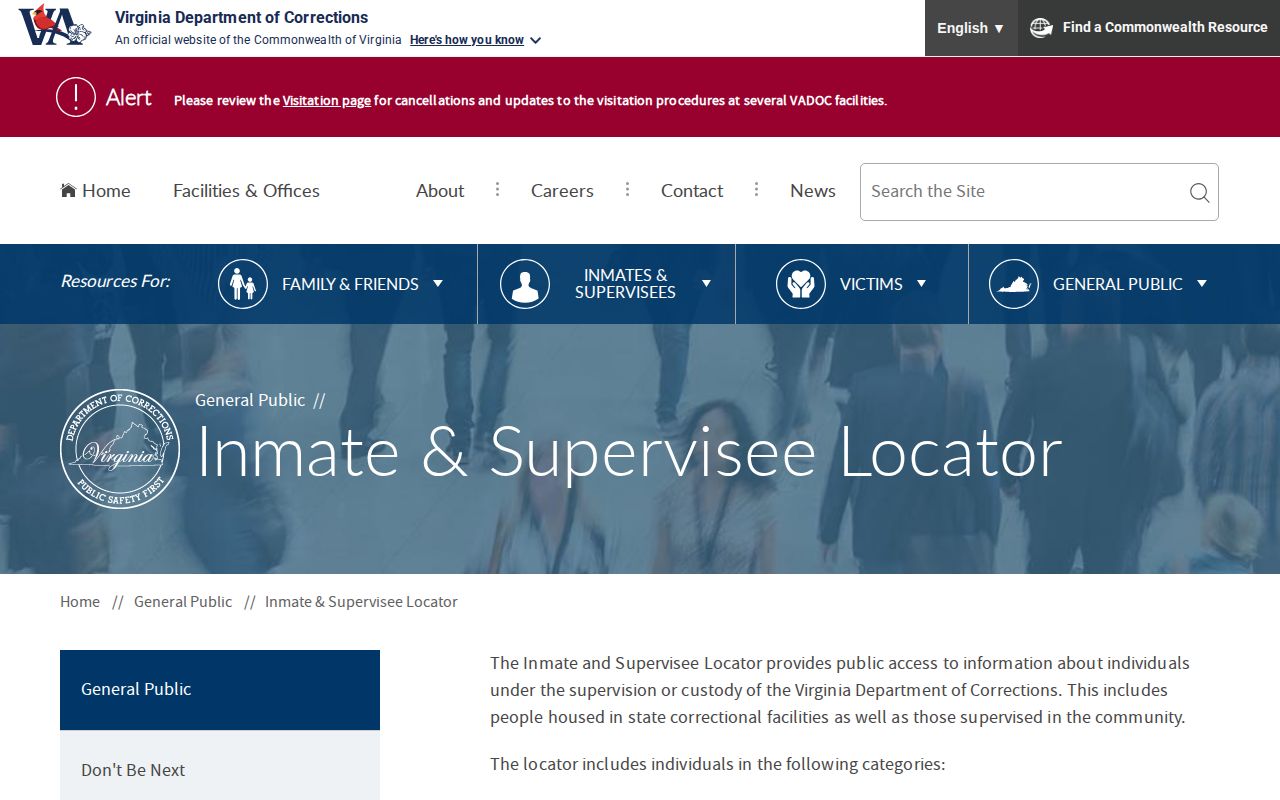
The captured screen shows where a Frederick state-custody search begins, but its result must be read in light of sentence authority and current status.
The full county custody-chain method is also explained on the Frederick County released-inmates home page.
Note: A current VADOC supervision result can mean prison custody ended while the state sentence remains under community oversight.
Frederick VADOC Release Date Fields
VADOC permits a search with at least the first three letters of the first name and the full last name, or with the seven-digit DOC ID. Optional location, race, gender, and age-range filters can narrow results. The locator covers people in VADOC institutions, institutional hospitals, the Community Corrections Alternative Program, probation or parole districts, and some local or regional jails while under state authority. VADOC says it updates daily and warns that data may be inaccurate or out of date.
| Field | How to use it | Release-date caution |
|---|---|---|
| Name | Enter the required first-name letters and full last name | Confirm identity with more than a common name |
| DOC ID | Use the seven-digit state identifier when known | It follows the state episode, not a short local booking |
| Location | Shows an institution, program, or supervision office when available | Community supervision is not full discharge |
| Status wording | Transcribe the displayed term exactly | Do not replace “transfer” or “supervision” with “released” |
| Future date label | Copy the interface’s current wording and date | It is prospective until a later event confirms it |
The static VADOC page does not establish whether every result currently labels a future date as projected, estimated, tentative, or something else. Do not substitute a familiar term. If a historical result is absent, request the custody-status, release, or discharge record from VADOC and compare it with the sentencing court.
Frederick Release Dates and Credits
Virginia uses more than one sentence-credit framework. VADOC separates Good Conduct Allowance, called GCA, from Earned Sentence Credits, called ESC. GCA generally applies to felony offenses before January 1, 1995 and misdemeanors before July 1, 2008. ESC generally applies to felony offenses on or after January 1, 1995. The offense date and statute version matter.
Virginia Code section 53.1-202.2 defines an earned sentence credit as one day deducted and authorizes credits for eligible felony offenses.
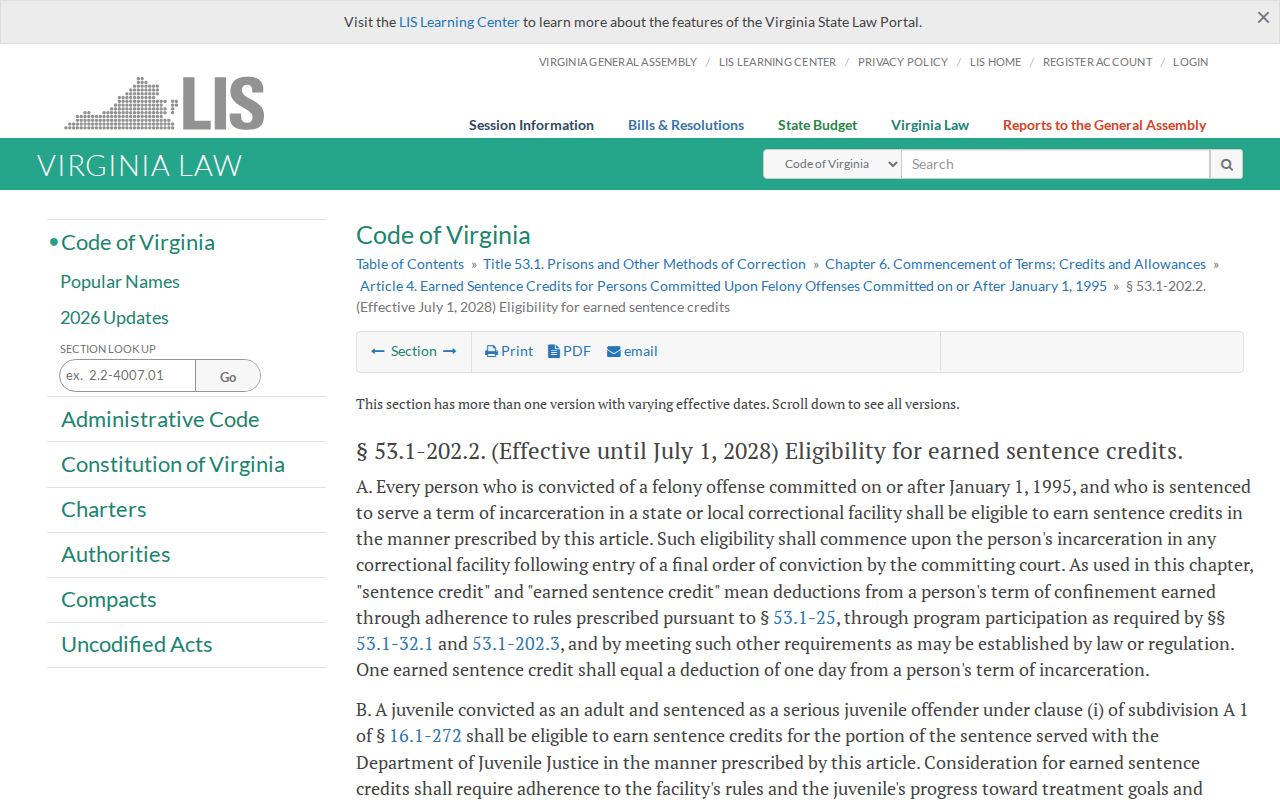
The statute view anchors the credit system in current Virginia law, which should be checked for the offense-date version that governs the sentence.
Virginia’s truth-in-sentencing shorthand says many covered cases require at least 85 percent service, based on the original maximum of 4.5 credit days for each 30 days served. It is not a universal current formula. Under section 53.1-202.3, listed offenses remain capped at 4.5 days per 30. Other eligible offenses can earn 15, 7.5, 3.5, or zero days per 30 based on classification.
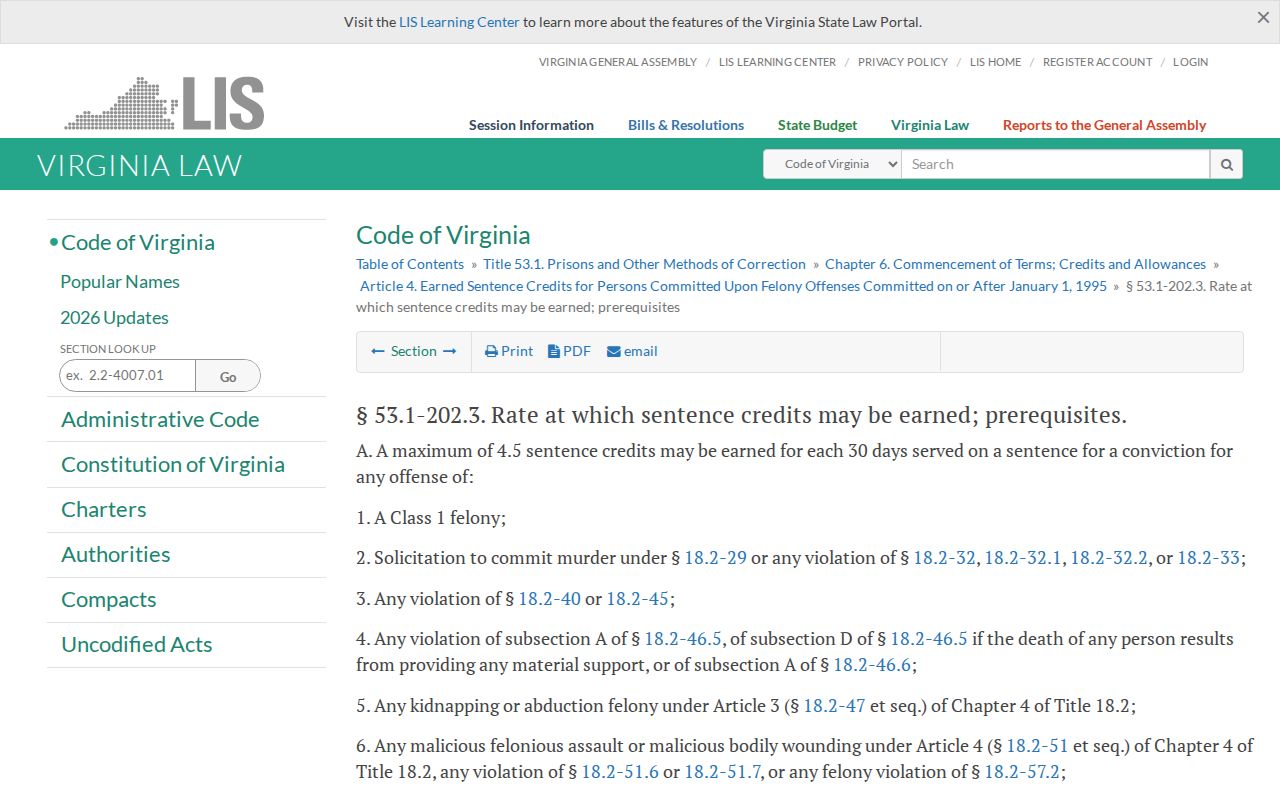
This source shows why the offense and classification must be known before anyone estimates a Frederick County state release date.
Section 53.1-202.4 governs criteria for earning, forfeiting, and restoring credits. Annual review, program participation, and discipline can affect classification.
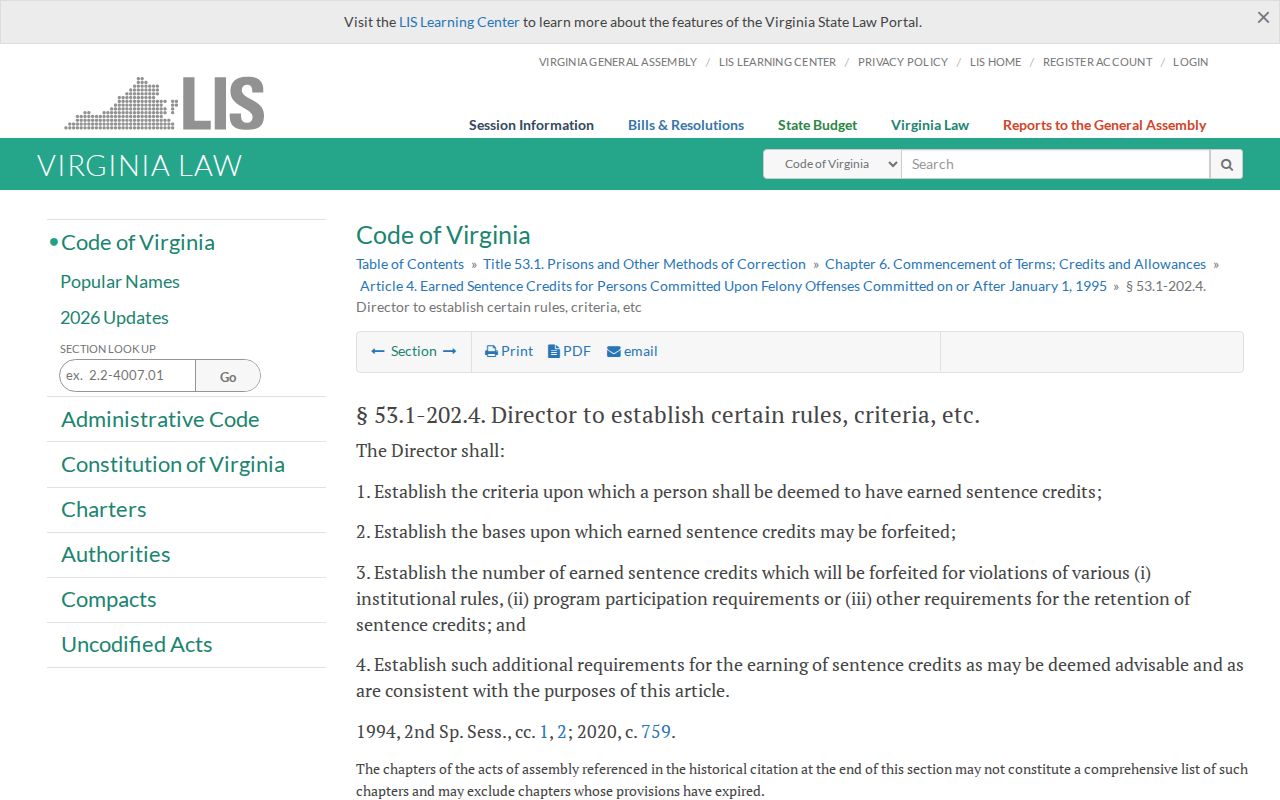
The captured law explains why a date can move after an earlier calculation, even without a new court sentence.
Frederick Local Jail Release Computation
A sentence of 12 months or less for a misdemeanor can fall under the local credit provisions in Virginia Code section 53.1-116. Unless a mandatory minimum applies, the statute permits one credit day for one day served without a rule violation, including qualifying pretrial days. The section also contains distinct rules for parole-eligible prisoners and certain facility activities. Post-1995 felony credit remains subject to the limits in the state earned-credit article.
NRADC’s public site does not publish its written credit policy or an online date calculator. Ask the jail for the existing computation and the sentencing court for the order. Confirm how jail credit, concurrent or consecutive terms, and other active cases were applied. “Concurrent” means terms run at the same time; “consecutive” means one term follows another.
VADOC calculates qualifying sentences with more than 12 months of active time, but physical placement and sentence authority can diverge. A state-responsible person can remain in a local or regional jail. That is why a Frederick County address does not by itself identify who computed the date.
Why Frederick Release Dates Change
A date may shift through routine sentence administration or a new legal event. The source should state whether the change came from the jail, VADOC, or the court. Never infer a reason from a changed web display.
| Factor | Possible effect | Best confirmation |
|---|---|---|
| Credit classification | More or fewer earned days | VADOC computation record and governing statute |
| Disciplinary action | Forfeiture or later restoration of credit | Custodian’s credit record |
| Jail credit correction | Recalculated time already served | Court order and computation |
| New or amended sentence | Concurrent, consecutive, shorter, or longer active term | Signed court order |
| Parole action | Conditional release path for an eligible case | Board decision plus completed VADOC release |
| Detainer or hold | Transfer to another custodian instead of community release | Release destination and receiving locator |
A transfer can happen before the projected end date of the next custody term. Likewise, a VINE release or transfer notice may follow an operational event without explaining its legal basis. Preserve each agency’s exact language.
Frederick Release Timing Versus Intake
NRADC says scheduled releases start at 5:00 a.m. That statement describes the jail’s operational release process. It does not change the sentence calculation and does not promise that everyone exits at that time. If another jurisdiction, facility, or VADOC controls the release, the receiving agency must be checked. A scheduled start time is not the same as a completed event time.
The adjacent work-release program has a separate intake rule. Official instructions say an evening entrant may wait until the next business day for processing. A Friday evening arrival may wait until Monday because intake processing does not occur on weekends or holidays. This is about entering work release, not a general weekend-release rule. Applying it to all NRADC releases would be inaccurate.
Work release also remains custody. A participant can leave the center for approved activity yet still be serving a sentence. Confirm the terminal discharge through NRADC and the court rather than treating daytime absence as release.
Note: NRADC’s early scheduled-release start and its work-release intake limits describe two different processes and must not be merged.
Confirm Frederick Completed Release Dates
For an NRADC event, request the booking number, release date and time, release reason or type, and transfer destination. Pair that record with the court order. For a VADOC event, seek the notification-of-release letter, signed Order of Release, and current custody or supervision record. VADOC says a person who satisfies the sentence is discharged or leaves on parole and signs applicable release conditions. Those completed records carry more weight than an old projection.
Virginia Jail VINE can alert on an NRADC release or transfer, while eligible victims use VADOC’s separate notification system for state custody. The Frederick VINELink Release Check explains how to register and read the reporting agency. VINE is corroboration, not a guarantee of the legal reason or final destination.
Federal dates belong in BOP records, and immigration custody belongs in ICE records. A past BOP release date means BOP custody ended, not that all federal supervision ended. An NRADC release followed by ICE or VADOC custody can be true in both systems. The responsible custodian’s completed event is the final check.
Keep a short evidence log. Record the retrieval date, exact URL, custodian, name or identifier used, displayed status, and any stated system limit. If two dates conflict, rank the completed event from the responsible custodian above the projection. Then test whether the records concern different stages, such as an NRADC transfer date followed by a later VADOC prison release.
Public Record Search
Sponsored Results