
Where BOP Releases Go
The Federal Bureau of Prisons controls sentenced federal incarceration. A person tied to Frederick County can serve at any suitable federal institution nationwide. Release from that institution may be followed by prerelease placement, community confinement, home confinement under federal authority, or supervised release administered through the federal courts and probation system. Those statuses should not be collapsed into an unconditional discharge.
A federal person can also leave NRADC while still in USMS custody. Contract housing and transport make physical location different from legal custody. If BOP never received the person, its locator may return nothing even though federal detention occurred. In that case, the federal docket, detention or release order, and USMS record matter more.
Confirm a BOP Release
The BOP Inmate Locator generally covers federal inmates released from 1982 forward. Search by federal identifier when possible. A name search requires first and last name and can use extra descriptors to narrow results.
- Search with a BOP register number, FBI number, DCDC number, or INS number when known.
- Otherwise enter the required first and last name, then compare middle name, race, age, and sex.
- Record the register number, displayed release date, location, and exact custody wording.
- Open the federal docket and judgment to identify the sentence and any supervised-release term.
- Check another custodian when transfer or immigration action is plausible.
The BOP record explanation supports treating a past date with no facility, “Released,” or “Not in BOP Custody” as proof that BOP custody ended. The Frederick County custody-chain search helps connect an earlier NRADC event to the federal record.
BOP Historical Release Fields
BOP results use a small field set. Each field should be saved with the retrieval date because it identifies the federal record without explaining every later legal duty.
| Field | Meaning |
|---|---|
| Name | Identity shown by BOP |
| Register number | Federal custody identifier |
| Age, race, sex | Descriptors used to distinguish matches |
| Release date | Date BOP reports for the custody episode |
| Location/status | Facility or released/not-in-custody wording |
The official BOP record explanation gives context for released results.
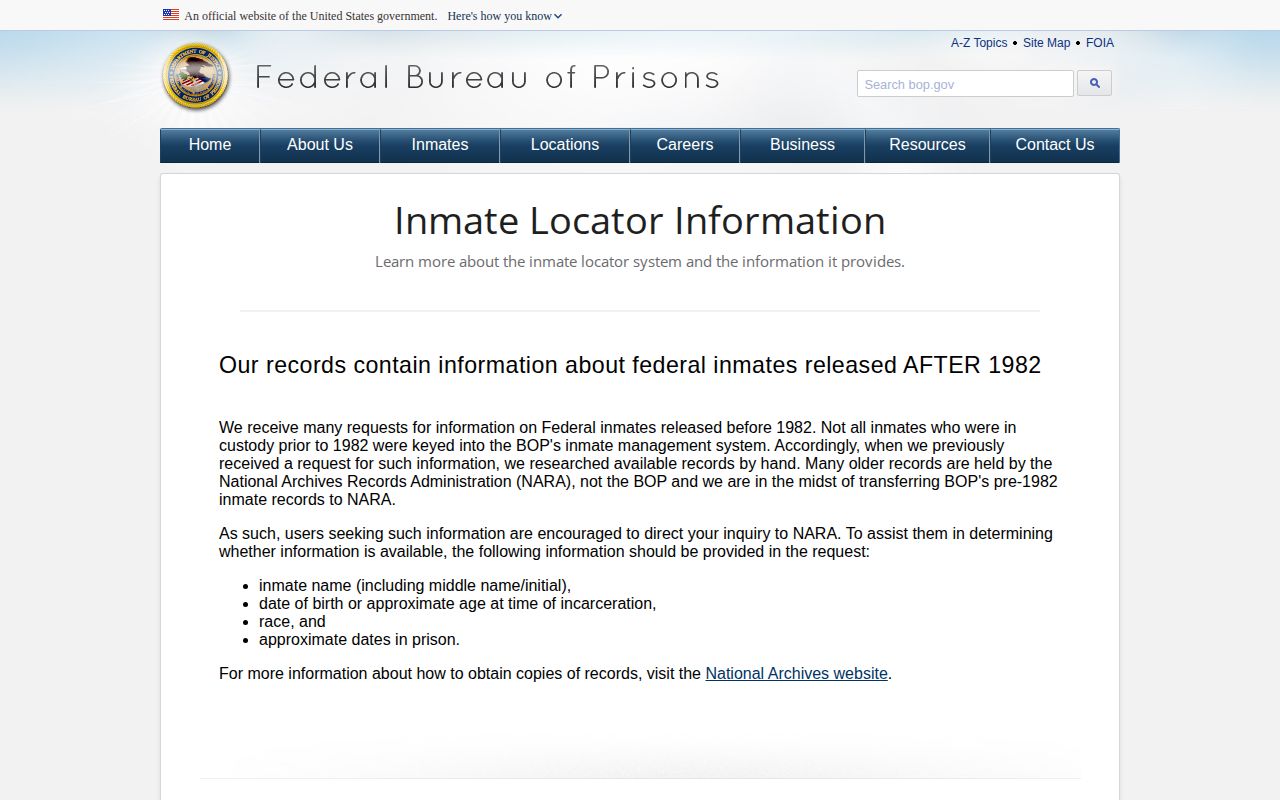
The source clarifies why a federal release result cannot be read as the end of court supervision.
BOP Release Records Contact
No BOP prison was identified within Frederick County, so no local federal prison address, phone, or visiting hours can be stated. Use the locator's institution when the person remains confined. For a historical release, use BOP's national records process and the federal court file.
Federal Bureau of Prisons
Nationwide federal prison system
No BOP institution identified in Frederick County
Use the official locator and FOIA channels
The BOP FOIA page explains access to agency records. A focused request should include the full name, register number, approximate custody dates, and the specific existing record sought. Personal records may require proof of identity or authorization under applicable procedures.
The official historical-record request page appears below.
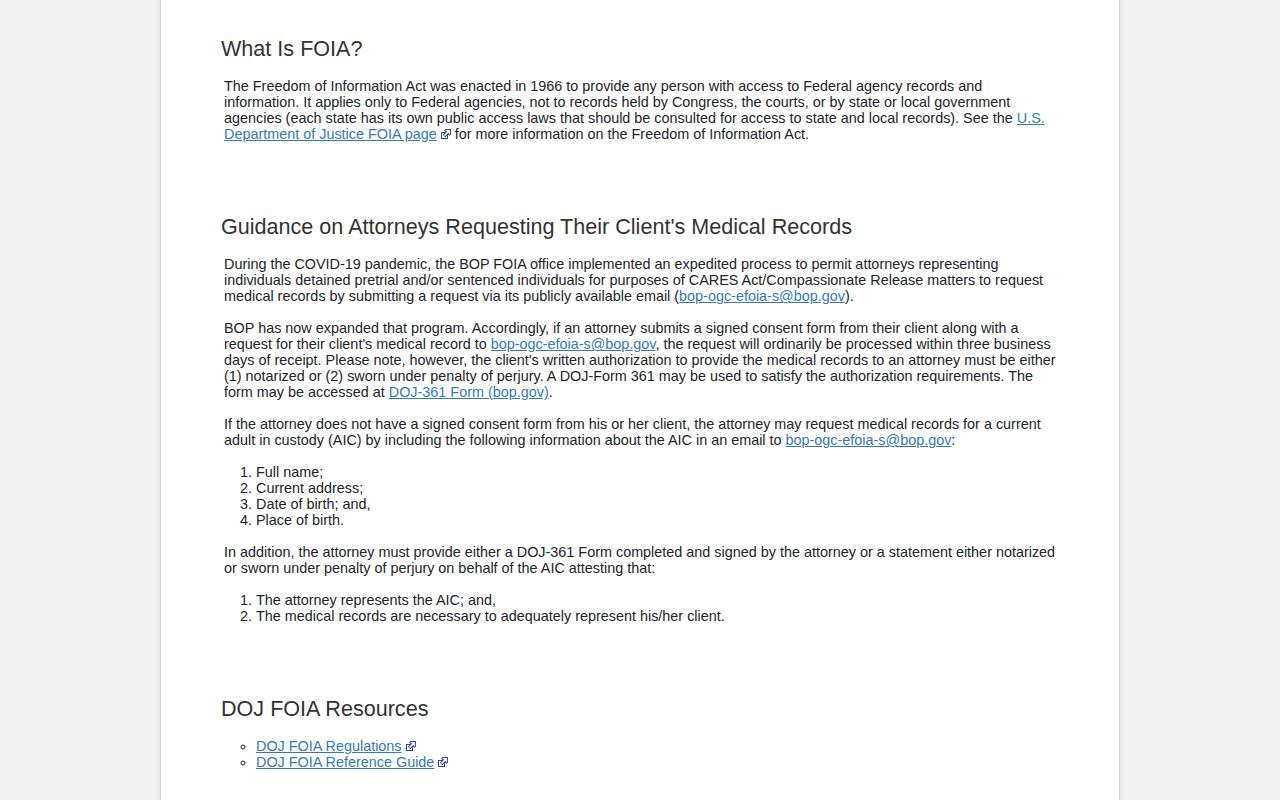
This route is the fallback when the public locator does not explain the federal custody ending.
USMS Versus BOP Custody
The U.S. Marshals Service commonly manages federal pretrial detention and movement. It can house a person in a contracted jail and transfer that person among facilities. USMS does not provide a public county-style historical release roster. A BOP no-result therefore proves little when the case never reached a sentenced BOP placement.
Use the federal docket to find the detention, bond, sentencing, or release order. The order states legal authority, while the physical custodian records the movement. The USMS prisoner information describes that role. Its FOIA system maintains prisoner-custody and Prisoner Tracking System records and accepts electronic requests.
Ask for the specific custody movement or release record, not a broad explanation. If NRADC held the person under federal authority, obtain the NRADC departure destination as well.
Federal Release Status Terms
Federal terms mark different stages. Keeping them separate prevents a BOP locator date from being stretched beyond what it proves.
- BOP custody
- Sentenced federal confinement controlled by the Bureau of Prisons.
- USMS custody
- Federal detention and movement, often before sentence or during court proceedings.
- Prerelease placement
- A BOP-controlled transition that may involve community or home placement.
- Supervised release
- Court-ordered federal supervision after imprisonment, administered through probation.
- Discharge
- The end of the particular custody or supervision term named in the record.
A past locator date is strong evidence that BOP custody ended. The judgment and probation record answer whether supervision continued. An ICE or state locator can answer whether a different custodian then held the person.
Frederick Federal Record Chain
Start the chain with the agency responsible at each stage. NRADC records can document a local booking or departure. USMS records can document federal pretrial control and movement. BOP records cover sentenced federal custody. The federal court explains detention authority, judgment, sentence, and supervised release. ICE or a state agency may control a later transfer.
| Question | Source |
|---|---|
| Was the person at NRADC? | NRADC booking and departure record |
| Who moved a federal detainee? | USMS and federal docket |
| Did BOP custody end? | BOP locator and records |
| Did federal supervision remain? | Judgment and probation record |
| Did another custody begin? | Named receiving agency |
A conflict often disappears when dates and custodians are aligned. One record can truthfully say NRADC released the person while another shows continued federal detention.
BOP Release Evidence Strength
A locator result is strongest when the identifier, identity fields, release date, and status all align with the federal case. Save the exact URL, retrieval date, search identifier, and displayed wording. A register number anchors the federal custody episode more safely than a name alone. Common names, aliases, and old data can otherwise link the wrong person.
The federal judgment explains the sentence and any supervised-release term. It may not record the actual hour when BOP completed processing. Conversely, the BOP result can show that its custody ended without explaining court conditions. Read both records. If prerelease placement occurred, ask BOP how the agency classified that phase rather than describing it from ordinary observation.
When the result is missing, test the custody path. A federal defendant may have remained under USMS and never entered a sentenced BOP institution. Another person may fall outside the locator's general post-1982 coverage. Identity data may also differ. Use the docket, USMS records, and a narrow BOP request before concluding no federal detention occurred.
If a past BOP release is followed by ICE, state, or local custody, cite the receiving record separately. The end of federal prison custody does not erase another hold. In the same way, later federal supervised release is a court status rather than BOP confinement. Scope each conclusion to the system that created it.
Request BOP Release Records
A practical request names the precise existing record, such as a custody-history entry or completed release record. Give the register number and a narrow date span. Ask for electronic delivery and applicable cost information. Broad questions may seek a new explanation the agency need not create, while focused wording points to a record BOP maintains.
For personal records, follow identity and authorization rules on the official request page. A public locator result does not waive those safeguards. The federal court clerk uses separate procedures for docket documents. Route the judgment request to the court and the custody request to BOP. Keep both responses with the retrieval dates so later custody changes remain clear.
BOP Release Date Context
A past release date in the locator is a strong completed BOP event, but the surrounding federal record still matters. The judgment may impose supervised release after imprisonment. Prerelease community placement can also make ordinary phrases such as “out of prison” imprecise while BOP authority continues. Use the agency's own label instead of guessing from physical location.
Federal release research should preserve three anchors: the register number, federal case number, and responsible custodian. The register number ties locator and BOP records together. The case number ties the judgment and later court actions together. The custodian identifies whether BOP, USMS, ICE, or another agency controlled the person on the date in question.
When NRADC appears in the chain, its record should state the federal transfer destination. That local departure may predate BOP intake and cannot substitute for the BOP release date. A clear timeline prevents separate federal events from being merged.
The locator should be searched again with a known identifier when a name-only search fails. A federal identifier reduces confusion from aliases and common names. Save the result even when it reports no current facility, because the release date and register number can still anchor a records request. If the person was held only for federal court proceedings, switch to USMS and the docket instead of forcing a BOP interpretation. That division respects which agency created each record.